

A new future for non-invasive temperature measurement
Historically dismissed as inaccurate, surface-mounted temperature measurement has evolved. Now it can offer the same accuracy and response times as invasive temperature measurement – without process interruption.

Executive summary
Temperature measurement sits at the heart of industrial process control. From controlling polymerisation to monitoring bioreactors, accurate temperature data underpins safety, quality, efficiency and regulatory compliance. For decades, the dominant approach has been to use invasive measurement techniques – thermocouples and RTDs inserted directly into the process stream inside thermowells for protection.
Yet invasive methods are not always suitable for demanding applications with high pressure, high flow velocity or corrosive/abrasive media. The requirement for safe and repeatable measurement in these applications is driving renewed interest in surface-mounted, non-invasive temperature sensors.
Historically viewed as less accurate or reliable, surface-mounted sensing technologies have evolved significantly. Today, advances in technology are reshaping what is possible. This white paper explores the historical challenges of surface-mounted temperature measurement, its growing relevance across process industries and the latest technologies redefining performance boundaries.
Introduction: The role of temperature measurement
Highly relevant for quality, safety and efficiency, temperature is the most measured parameter in the process industry. The challenge is to measure the process temperature accurately and in a reproducible way across different applications and industries. Traditional practice favours in-process immersed sensors.
These methods offer direct contact with the process fluid, typically delivering high accuracy and fast response. However, installation requires downtime, cutting and welding, and contamination risks arise in regulated industries. On the other hand, surface-mounted measurement – placing the sensor on the exterior of the pipe or vessel – removes process intrusion. Once dismissed as imprecise, surface-mount is increasingly viewed as a viable, low-risk alternative under the right conditions.
Historical limitations and challenges
Surface-mounted or ‘clamp-on’ temperature measurement has long faced scepticism. Several technical barriers contributed to its limited adoption, namely reduced accuracy due to measurement interference, poor heat transfer and environmental influences.
Unlike immersed probes, surface sensors rely on conduction through the pipe wall. Early designs suffered from poor thermal coupling, air gaps between sensor and surface, and inconsistent installation. These factors introduced measurement lag.
In addition, external measurements are inherently exposed to interferences from ambient temperature variation, airflow and convection, heat loss and solar loading. Without compensation, readings often reflected environmental conditions rather than the true process temperature.
Irregular pipework, insulation thickness, coatings and vibration further degraded reliability. Achieving repeatable performance required skilled installation and frequent recalibration.
All in all, when safety, yield and compliance depend on precise readings, conservative design practices have favoured direct immersion – even at higher cost and risk.
Latest technologies
Manufacturers have taken different routes to try to reduce the external influences on surface-mounted temperature sensors. One approach is to clamp a traditional temperature sensor to the outside of the pipe and take two temperature measurements: one from the pipe wall and a second measurement either in the terminal head or directly above the pipe surface. These two measured temperatures are used, in conjunction with a mathematical algorithm, to calculate a synthesised process temperature. However, as this is an artificially produced value, inaccuracies can result, prompting concerns around safety and regulatory requirements.
Endress+Hauser’s iTHERM SurfaceLine TM611 takes a different approach. The sensor is based on an enhanced thermal coupling element, which is shaped to match the outer diameter of the pipe and coated with a heat-transfer material. This material deforms during installation, ensuring that any imperfections in the pipe – scratches, pitting or corrosion – are filled. This stops air pockets from forming and affecting heat transfer.
In addition, for small pipe diameters the measuring element can be inclined to increase the contact surface area between the sensing element and the pipe wall. This avoids poor heat transfer from small surface areas, making the TM611 suitable for diameters as small as 8mm.
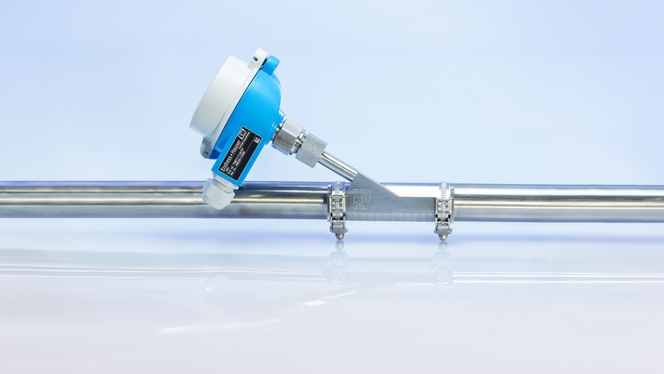

Inclining the measuring element improves heat transfer, and therefore accuracy, in small pipe diameters by increasing the contact surface area.
Temperature measurement in a chemical process, comparing invasive and non-invasive measurements taken at the same point on the pipe at a sampling rate of 1 second. Non-invasive measurement provides nearly the same results as invasive measurement and can even be faster.


Inclining the measuring element improves heat transfer, and therefore accuracy, in small pipe diameters by increasing the contact surface area.

Temperature measurement in a chemical process, comparing invasive and non-invasive measurements taken at the same point on the pipe at a sampling rate of 1 second. Non-invasive measurement provides nearly the same results as invasive measurement and can even be faster.


Field trial data from the power & energy industry shows that the TM611 reliably follows the temperature development of the process, comparable to invasive temperature measurement, whereas the sensors relying on electronic compensation are affected by environmental influences such as wind and ambient temperature changes.
Benefits of non-invasive measurement
With the deployment of these new technologies, non-invasive temperature measurement offers a range of practical and economic advantages that make it increasingly attractive across process industries.
One of the most immediate advantages is the elimination of mechanical intrusion into the process system. Traditional in-pipe temperature measurement requires drilling, welding and the installation of thermowells or probes into the process stream. These activities introduce potential risks, including structural weakening, leaks and corrosion around welds. As they are mounted externally, surface-mounted sensors remove a source of mechanical failure and simplify engineering design, particularly in high-pressure or hazardous environments where any penetration must be carefully justified.
Installing intrusive sensors requires the process to be drained, depressurised and isolated from upstream and downstream systems. In continuous or high-throughput operations, this can be extremely disruptive. Surface-mounted measurement avoids these requirements entirely. Sensors can typically be installed while the process remains fully operational, eliminating the need for product loss, system flushing or downtime. This is especially valuable in industries such as:
- Petrochemicals, where shutdowns are costly and hot works are carefully controlled
- Chemicals, where drain-down presents a risk to personnel and environment
- Life sciences, where cleaning and validation cycles are time-intensive
- Food & beverage, where product waste and downtime must be minimised
Because surface-mounted sensors do not involve penetration or hot work, installation can often proceed under simplified or minimal permits. This reduces administrative overhead and accelerates project timelines, particularly in regulated or high-risk environments.
Surface-mounted sensors can usually be installed in a fraction of the time, often in minutes rather than hours or days, depending on accessibility. This enables rapid deployment across multiple measurement points, installation during normal operations and minimal disruption to production schedules. For brownfield sites or retrofit projects, this advantage is particularly compelling.
Applications across process industries
Surface-mounted measurement is suitable for a wide range of industries, and is particularly attractive where safety or retrofit feasibility are priorities. As well as being ideal for heavy industries dealing with high process pressures or hazardous chemicals, its non-contact nature makes surface-mounted technology a good match for the hygienic needs of the food & beverage and life sciences industries.
Petrochemical and refining
Used for:
- Monitoring pipe skin temperatures
- Heat tracing validation
- Corrosion-under-insulation (CUI) risk mitigation
- In hazardous environments, minimising process penetrations reduces exposure and maintenance complexity
Power generation
Applications include:
- Steam line monitoring
- Boiler tube profiling
- Heat exchanger performance tracking
Chemical and life sciences
In highly regulated environments:
- Clean-in-place (CIP) processes benefit from non-invasive measurement
- Contamination risks are reduced
- Validation protocols are simplified
- Surface sensors support compliance without compromising sanitary design
Food & beverage
Penetrations can create microbial harbourage points. Surface-mounted sensors support:
- Pasteurisation monitoring
- Jacketed vessel temperature tracking
- Energy optimisation
Water & wastewater
Used for:
- Freeze protection
- Energy balancing
- Environmental monitoring
Conclusion
Surface-mounted temperature measurement has evolved from a niche workaround to a strategic instrumentation option. Modern technologies significantly reduce historical limitations, providing similar accuracy and response times to comparable invasive temperature measurement – and even exceeding them in some applications.
For organisations balancing safety, cost, uptime and energy management goals, non-invasive solutions offer compelling advantages – particularly in retrofit and high-risk environments.
The key is not choosing between invasive and non-invasive measurement categorically but deploying each where it delivers maximum value. With thoughtful implementation and modern techniques, surface-mounted temperature sensing is positioned to play a central role in the next generation of process industry operations.
For more information, visit redefining non-invasive temperature measurement.
